

News from SKPOS – 1st half of 2026
Change of IP Address
For security enhancement, the SKPOS service is replacing the original IP address with a domain. The original IP address will remain functional on all devices until 31 December 2026. By this date, the original IP address must be replaced with the new domain. The address must be updated on all devices or applications that access the SKPOS service in real time: geodetic instruments, agricultural machinery, construction machines, drones, etc. More information, including instructions on how to change the IP address, can be found on the prepared webpage: skpos.gku.sk/ip.
End of operation of the SKPOS_CM_23 mountpoint
The operation of the SKPOS_CM_23 mountpoint will be terminated on December 31, 2026. After this date, RTK corrections in the outdated RTCM 2.3 format will no longer be provided. We recommend switching to newer correction formats - SKPOS_CM_32, which supports all available satellite systems, or SKPOS_CM_31, designed for receiving corrections from GPS and GLONASS systems.
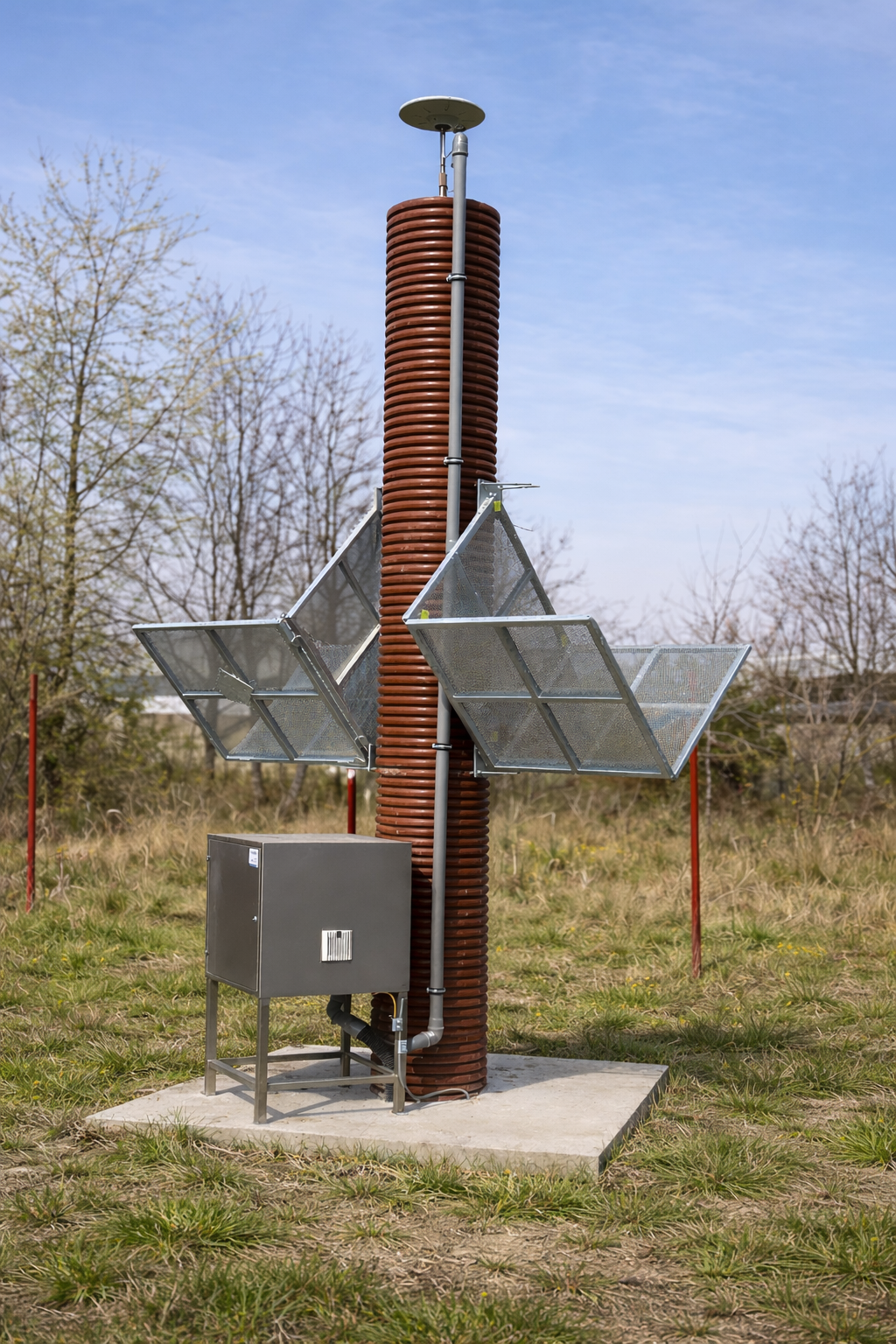
New reference station BRAT (Bratislava)
In March, a new reference station BRAT, located in the Bratislava–Trnavka area, was connected to the network. This marks the 38th active reference station in Slovakia.
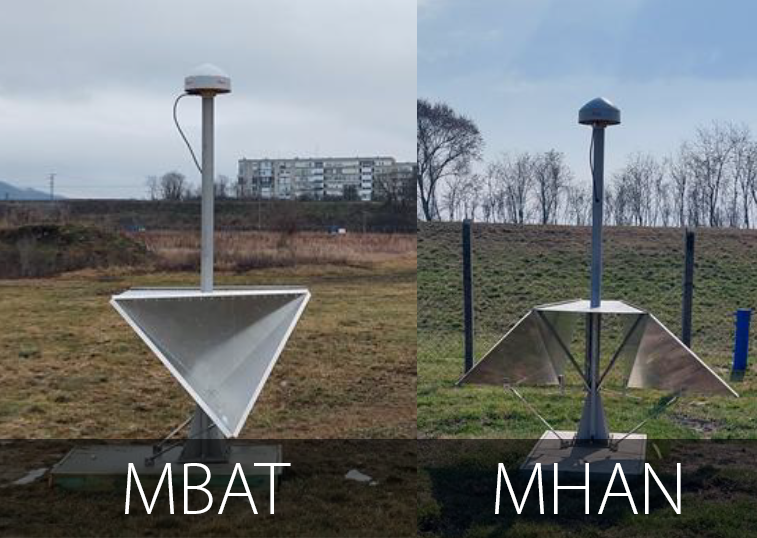
New Hungarian stations MBAT and MHAN
Two new Hungarian stations, MBAT (Bátonyterenye) and MHAN (Jánossomorja), have been connected to the network solution. At the same time, the receivers and antennas were replaced, enabling all Hungarian stations to fully support the third-generation BeiDou system.
New Monitoring Station LMST (Lomnický Štít)
In collaboration with the Department of Global Geodesy and Geoinformatics at the Faculty of Civil Engineering, SUT, the station on Lomnický štít (LMST), was connected as physical monitoring stations. The SKPOS network is thus monitored even under extreme conditions—right on Slovakia’s second-highest peak.

Receiver Firmware Upgrade
All receivers have been upgraded to firmware version 6.50. The update brings several technical improvements in the areas of GNSS signal tracking, RTK performance, security, and system stability. The most significant changes include improved resistance to jamming and spoofing, fixes to the NTRIP communication header, optimizations for Galileo and GLONASS satellites, improvements in processing during increased ionospheric activity, and security updates for network communication.
SKPOS Service Survey
In May, we asked you to evaluate the SKPOS service through a short, anonymous survey. We are very pleased that nearly one in four users of the service participated in the survey. This level of participation has provided us with valuable insight into how you perceive SKPOS and where you see room for further improvement. As many as 97% of respondents stated that they are very satisfied or satisfied with the SKPOS service. We also greatly appreciate your suggestions for improvement. You sent us more than 100 suggestions and recommendations in the questionnaire, which we are gradually analyzing. Many of them provide valuable inspiration for the further development of SKPOS services. Thank you for your trust and constructive feedback.
List of supported antennas published in the SKPOS Online Postprocessing application
The SKPOS Online Postprocessing application allows for the processing of static GNSS measurements via a web interface, without the need for dedicated postprocessing software. To ensure the correctness of the calculation and achieve the required accuracy, it is essential that the GNSS antenna used is supported by the application. For this reason, a list of supported GNSS antennas has been published on the SKPOS website.

Record number of simultaneous connections
During the second week of April, we set a record for the number of simultaneous connections, reaching 999 in a single second. In the attached animation, you can see all user connections throughout that day—a full 24 hours compressed into 10 seconds.
Publications and Presentations
Over the past six months, we have presented two papers:
- at the GNSS 2026 conference, we presented information about development of quality monitoring for the SKPOS network solution and its comparison with the grid-check method,
- At 3GON TECHDAYS 2026, we provided information about SKPOS – centimeter-level accuracy for positioning and navigation.